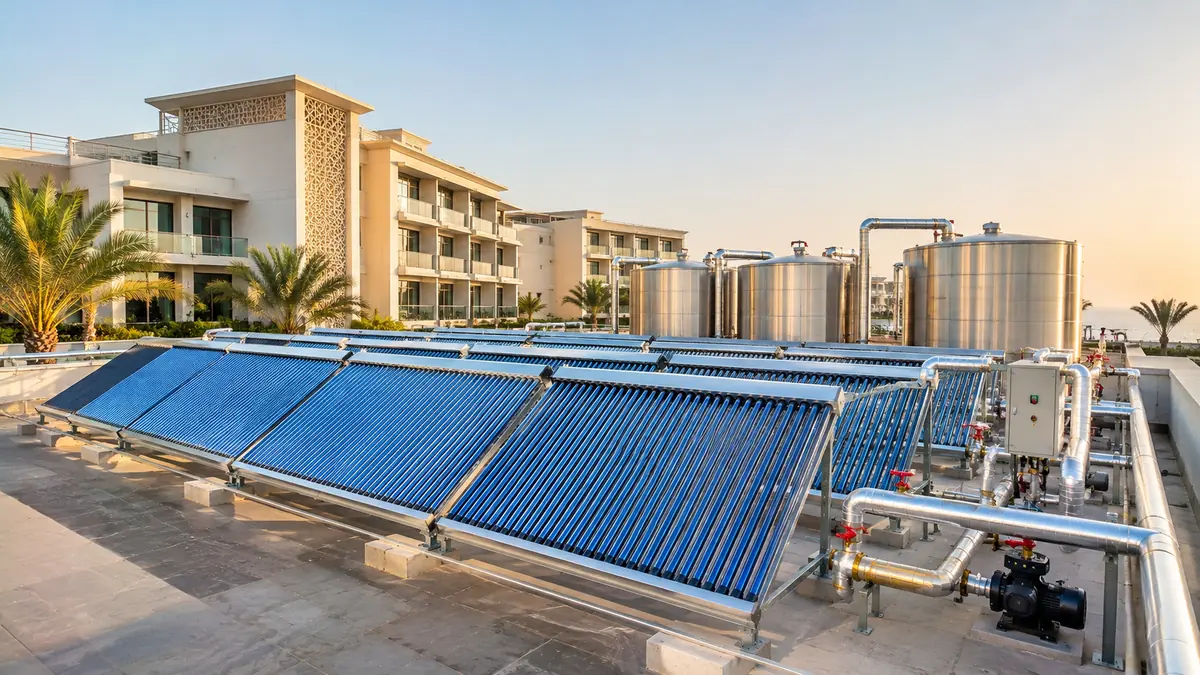
A commercial solar water heater is a larger, usually pumped system, with multiple collectors, bigger storage and controls, designed around a building’s peak hot water demand. In most commercial buildings it works alongside existing water heaters, boilers or heat pumps as a solar pre-heat, so the existing plant only tops the water up.
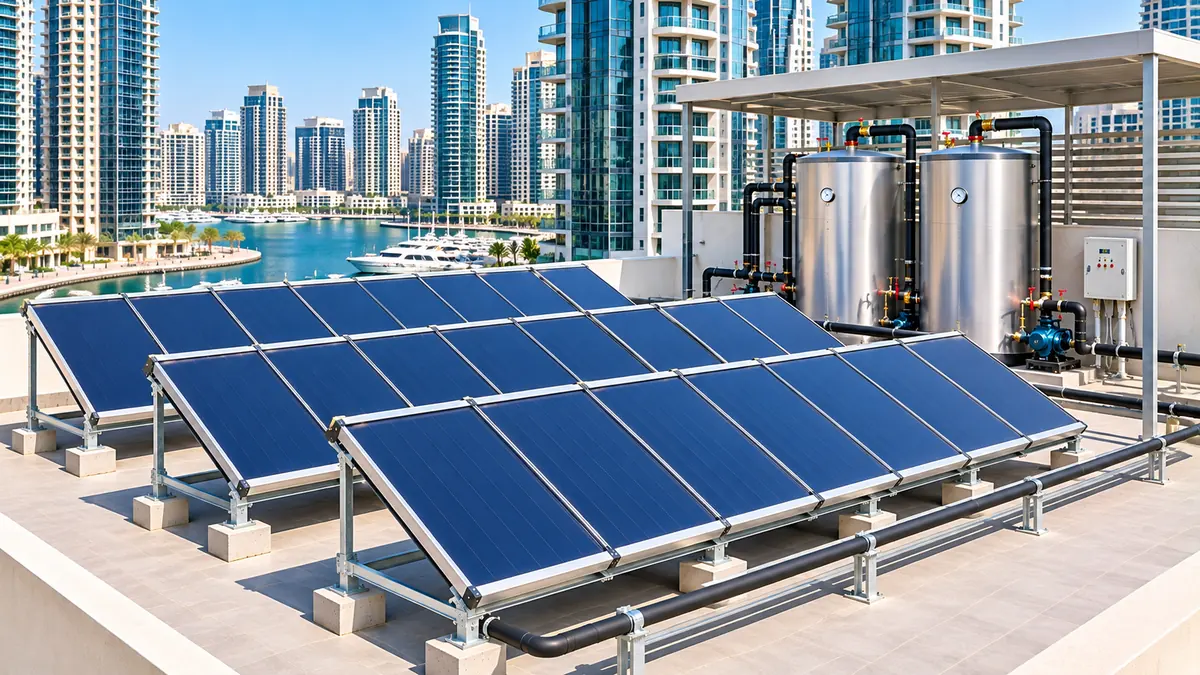
Solutions by Sector
Hotels and serviced apartments
- Main hot water challenge
- Guest-facing reliability, with kitchens, laundry and spa demand
- Sector guide
- Hotels
Staff and labour accommodation
- Main hot water challenge
- Very high peaks at shift changes
- Sector guide
- Labour accommodation
Schools
- Main hot water challenge
- Timetable-based demand and long summer holidays
- Sector guide
- Schools
Hospitals and clinics
- Main hot water challenge
- Continuous demand, redundancy and water safety
- Sector guide
- Hospitals
Industrial sites
- Main hot water challenge
- Process temperatures and volumes
- Sector guide
- Industrial
Gyms, spas, restaurants, offices
- Main hot water challenge
- Shower and kitchen peaks
- Sector guide
- Contact us
How a Commercial Solar Water Heater System Is Designed
1. Establish demand
We look at occupancy, fixtures, kitchen and laundry use, operating hours and, where available, metered water or energy data. The peak hour usually matters more than the daily total.
2. Decide the solar fraction
Few commercial buildings are designed to run on solar alone. The design sets what share of the annual hot water energy solar should provide, based on roof area, budget and demand.
3. Integrate with existing plant: solar pre-heat
In a pre-heat design, cold water passes through solar storage first. It arrives at the building’s existing calorifiers, boilers or heat pumps already warm, so they use less energy to reach the set temperature. This keeps the existing plant as the guaranteed backup and makes solar easy to add to existing buildings.
4. Choose collectors and layout
Collector type, number and arrangement depend on the roof, orientation, shading, wind exposure and maintenance access.
5. Controls and monitoring
Differential controllers manage the pumps. Larger systems may link to the building management system (BMS) for alarms and performance tracking.
6. Overheat and stagnation protection
UAE summers, and periods with no hot water draw, can push collectors to very high temperatures. Commercial designs need overheat protection built in from the start.
Working With Consultants and MEP Contractors
- Design support Demand calculations and system selection
- Material submittals Datasheets, drawings and documents for consultant approval. See supply
- Supply-only or supply-and-install packages
- Testing, commissioning and O&M manuals at handover
Operation and Maintenance
A commercial system serves many users, so maintenance has to be planned, not reactive. Most operators choose an annual maintenance contract covering scheduled visits, collector cleaning, pump and controller checks and reports. See also installation in the UAE, and our commercial solar water heating systems.
What Affects the Investment
We don’t quote standard prices for commercial systems. The main cost drivers are demand and the solar fraction, roof area and access, integration with existing plant, controls and monitoring, and site working constraints. We provide a costed proposal after the assessment.
Frequently Asked Questions
Can solar be added to an existing commercial hot water system?
Usually, yes, as a pre-heat. The existing plant stays in place as the backup.
How much hot water can solar provide for a commercial building?
It depends on roof area and demand. We calculate this during design rather than quote a general figure.
Do you work through consultants and contractors?
Yes. We can support design, provide submittals and supply or install as part of a wider project.
Request a Commercial Solar Water Heating Consultation
Tell us the building type, emirate, occupancy and current hot water system, and attach drawings or roof photos if available.